
The Short Answer
An experience centre is usually judged on whether visitors leave impressed. That is worth having, but it is rarely what decides the outcome. A centre can open to genuine admiration and still not move anyone to back the technology.
The test that matters is what a visitor can repeat once they have left the building: one true thing about your work, in their own words, without you there to help. Call it the retelling test. It is a harder standard than it sounds, and it is worth settling at the first design review, while the answer can still shape the build rather than be retrofitted into it.
Why you built it in the first place
You approve an experience centre because you already know something about how technology gets backed. The quality of the work does not secure its future on its own. Investors and institutional partners do, and those people respond to what they can walk through far more than to what they are shown on a slide.
The decision to build is rarely the mistake. The harder part comes after it. You appoint a lead, approve a budget, and for months afterwards you are shown concepts, visitor journeys and renders. Each looks considered. And at each review you are asked, in effect, to pass judgement on a discipline that is not your own. The question you are carrying, whether any of this will move someone to back the technology, is not one a render can answer.
So what should you be judging it against?
The room you are not in
An impressed visitor is a real asset. Doors open, follow-up meetings happen. No experience centre should aim for less.
But consider what happens after your most important visitors leave. The fund manager reports back to an investment committee. The government visitor briefs a minister, or defends a budget line. The donor makes a case to their own board. In every one of those rooms, your technology is being represented by someone who is not an engineer or a scientist, and you are not there to help.
That is where the outcome is actually decided. The visit earns their attention. What they can retell earns their advocacy.
So here is a standard you can hold the work to, from the very first review. Can a visitor with no background in your field walk out and repeat one true thing about your technology, in their own words? And is that one thing close enough to something they already care about that they can defend it without you in the room?
What one true thing looks like
Almost nobody is neutral about durian. Far fewer people know where the smell comes from. As the fruit ripens, it switches on a family of genes that manufacture sulphur compounds. That is the smell.
A visitor who leaves with nothing but that has understood what a genome does. It stops being an abstraction. It becomes the set of instructions behind a smell they already have strong feelings about.
A visitor from Beijing or Boston may never have seen a durian. They will still understand the idea, which is why it travels home with them.
That is a harder brief than making dense science look impressive.
A garden on a hospital campus
The scientists who found those genes work at the SingHealth Duke-NUS Institute of Biodiversity Medicine, and their garden sits on the Singapore General Hospital campus. The SGH Bicentennial Genomic Garden runs to 3,400 square metres and holds around a hundred regional species, a subset of which have had their genomes sequenced. Visitors reach its digital layer by scanning a code as they walk.
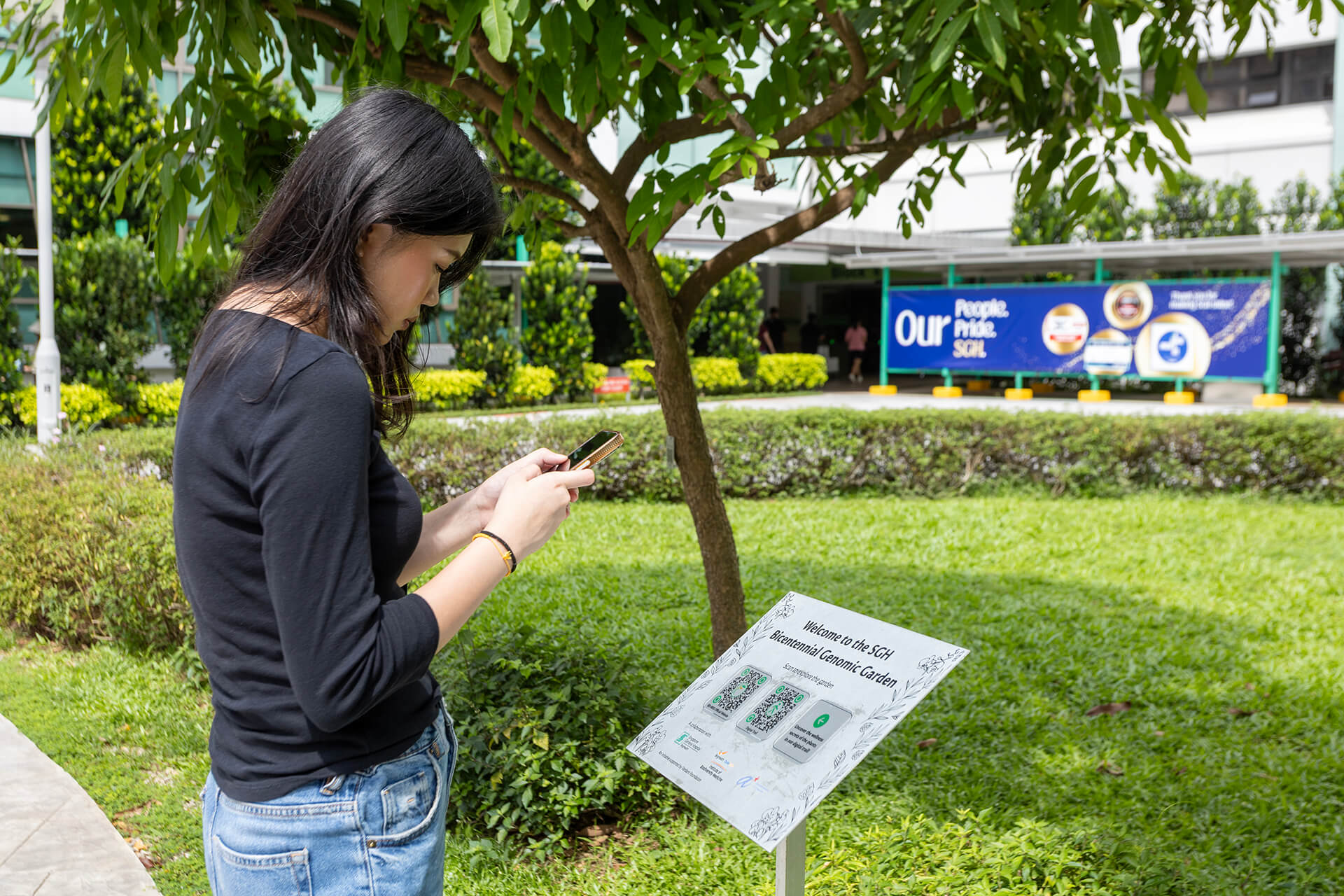
We built that layer, first as one narrative and later as three routes through the same planting. A visitor can now enter the science through food, through scent, or through the research itself if that is what they came for. Nothing was replanted. What changed was which door they come in through.
Whether it worked is not settled by how the place photographs. It is settled by what happened next, and none of what happened next was ours to arrange. SingHealth Duke-NUS Institute of Biodiversity Medicine published the model in Cell Genomics as a guide for others who want to build one. The Asian Development Bank’s Southeast Asia Development Solutions programme featured the digital experience. A joint laboratory in Brunei followed a visit that was hosted in the garden itself. And in 2026 a commercial developer, CapitaLand, opened a second genomic garden at the heart of Geneo at Singapore Science Park, designed with SingHealth Duke-NUS Institute of Biodiversity Medicine.
That last one answers the question in the title. The second garden exists because someone walked the first, understood it well enough to want one, and was senior enough to make it happen. The test in the title, answered by somebody other than us.
The moment that tells you it is working
One part of this is about leadership rather than design, and it is the part most worth passing on. For any of it to exist, a group of well-regarded researchers had to agree to let their work be told through fruit and fragrance. It is natural to hesitate there. Their leadership backed it anyway.
That moment will arrive in your project too. Someone will propose telling your science through something that feels, at first, almost too ordinary. Recognise it when it comes, because it is usually the sign that the translation is working rather than a sign the science is being diminished.
How it goes wrong
Rarely on opening day, which is what makes it expensive.
The common version starts with hardware. Screens and interactive kit are easy to specify, easy to price and easy for a board to approve, because they are the part of the project that looks like a decision. The technology gets chosen early and the story is fitted to it afterwards. The centre opens, it photographs beautifully, and visitors leave admiring the execution without being able to say what the technology is for.
The second version is that the translation gets delegated. Your scientists are consulted for accuracy but never for meaning. The result is accurate, complete, and lifeless.
The third is quieter and shows up after opening. You measure what is easy to count. Footfall, dwell time, satisfaction scores. All of them will look respectable in a centre nobody can retell, which is precisely why they are the numbers that get reported.
The first two have the same early symptom. Ask what a visitor should take away, and you are handed a list. The list is the symptom.
Four questions for your reviews
Three routes were the right answer for an outdoor garden with a public mandate and a donor pipeline. They are not a template. Your facility may need one tightly built journey, or something else entirely. That is your team’s decision. But these four questions will tell you, long before opening day, whether the thinking behind it is sound.
What is the one thing a visitor should be able to repeat after they leave?
A strong answer is a single sentence. If the answer is a list, the spine has not been found yet, however far along the build is.
Who outside our field have you tested this on, and what did they say back?
The retelling test only works if somebody actually retells it. Ask to hear what a non-expert said in their own words, not the summary of it.
How does this meet each of our key visitors?
A minister on a twenty-minute walkthrough, an analyst doing diligence and a first-time member of the public enter from different places. Several pathways or one narrative at different depths can both be right. What matters is that someone chose, for a reason.
How will we know, six months after opening, that it worked?
Decide now what you will count, and make at least one measure something outside your own walls: a partnership, a publication, a funding decision, an invitation. Agree on them before launch, and “did it work” becomes a question with an answer rather than a matter of opinion.
Beyond genomics
None of this is particular to genomics, and it is not particular to research institutes. It applies to any field where the work itself cannot be seen. Applied AI. Quantum computing. Advanced materials. Semiconductors. It applies just as squarely to a technology company’s brand experience centre or innovation centre, where the visitor is a customer, a regulator or an acquirer rather than a funder, and the thing being judged is still whether they can explain your technology to someone else afterwards.
In all of them, the people deciding whether to back the work are not the people who understand it. The domain changes and the task does not. It is always the work of turning what the technology is into what it means to the person making that decision.
Weeks after the visit, your most important visitor explains your technology to the people they answer to, and wins their support. That moment is what the experience centre was built for. The four questions are a way of checking, review by review, that the work is still heading towards it.
Questions this might raise
How do I measure whether a technology experience centre actually worked?
Weeks after the visit, can someone who was there repeat one true thing about the technology in their own words, to someone who was not? That is the retelling test, and it is the measure. Not whether they were impressed on the day, and not how well the place photographs.
At the SGH Bicentennial Genomic Garden, that showed up in what followed. A joint laboratory in Brunei. A feature by the Asian Development Bank’s Southeast Asia Development Solutions programme. A second genomic garden now open at CapitaLand’s Geneo development at Singapore Science Park. The institute also published the model in Cell Genomics for others to build on. None of those were targets anyone set. They followed from people being able to explain the work to someone else.
Why do technology visitor centres fail?
Usually not on opening day. Three failures account for most of it. The technology gets specified first and the story is fitted around it afterwards. The translation gets delegated, so scientists are consulted for accuracy but never for meaning. And after opening, the centre is measured on footfall and dwell time, which look respectable even when nobody can retell what they saw.
The early symptom of the first two is the same. Ask what a visitor should take away, and you are handed a list rather than a sentence.
What should I ask my experience design consultant before opening day?
Four questions. What is the one thing a visitor should be able to repeat after they leave. Who outside our field you have tested it on, and what they said back. How the design meets each of our key visitor types. And how we will know, six months after opening, that it worked.
The first answer should be a single sentence rather than a list. The last should include at least one measure from outside your own walls, such as a partnership, a publication or a funding decision.
Does one exhibition or trail work for every type of visitor?
Sometimes. The question to settle is not how many pathways you need, but whether your visitors genuinely arrive for different reasons. At the SGH Bicentennial Genomic Garden they did: a donor, an agency delegation on a guided tour and a family walking through on a Saturday are not the same brief. So the answer there was three routes under one theme. A facility with a narrower audience is usually better served by one well-built narrative. What rarely works is a single path stretched to accommodate everyone.
We are a technology company, not a research institute. Does this apply to our experience centre?
Yes, and the stakes are usually more immediate. A corporate experience centre or innovation centre is judged by customers, partners, regulators and sometimes acquirers, all of whom go back and explain what they saw to people who were not there. A procurement lead who cannot describe your differentiator to their own committee is the same failure as a fund manager who cannot describe a genome to theirs.
The four review questions are unchanged. The only thing that changes is who the visitor has to convince when they get back.
Does this standard apply outside genomics and the life sciences?
Yes. It applies wherever the work is hard for an outsider to picture, including applied AI, quantum computing and advanced materials. In all these fields, the people who decide whether to back your work are rarely the people who understand it. So always begin with why the work matters to them, rather than with how it works. The harder the science is to picture, the more rests on getting that right.