
The pressure to add AI rarely comes from visitors. It comes from the meeting room, the brief, the benchmark.
AI signals relevance, innovation, future-readiness. When everyone is talking about it and doing it, opting out feels like falling behind. But the wrong use of AI does not make an experience feel advanced. It makes it feel unnatural. Rigid. The audience does not leave impressed. They leave aware that something was trying to impress them.
And yet the pattern repeats. The budget gets approved. The AI goes in. The reviews come out. That is usually when the right question finally gets asked: did we need this?
The AI for AI’s sake fallacy
If a simpler solution would have worked, AI was never the answer. A conversational interface nobody asked for. Personalisation that adds steps instead of removing them. A “smart” interaction that slows down a room full of people who just want to get through.
These things look impressive in a demo. In a live setting, the audience just feels the friction. They do not know it is the AI. They just know something is in the way.
Novelty is not the same as value.

The “back to basics” pivot is not a step backward
Sometimes the most useful thing a team can do is stop and ask why. Not “what can AI do here” but “why do we need AI here?” What are we trying to make the audience feel, and what is the simplest way to get there.
That question has a habit of exposing the real answer. Better pacing. Clearer writing. A more considered sequence of moments. Not because these are cheaper or easier, but because they do not ask anything of the audience. Visitors are not there to work through a system. They are there to feel something. The moment your experience requires effort to operate, you have lost most of the room.
A successful experience is not one where the audience notices what went into it. It is one where they feel it before they understand it.
Where AI earns its place
Some experiences are too complex, too bespoke, or too personalised for any fixed solution to handle. That is where AI truly earns its place.
- Visualising what does not exist yet
Sometimes the problem is visibility. How do you make an audience care about something that does not exist yet? Something too complex to sketch, too vast to summarise, too abstract to feel real. AI can close that gap, not by explaining the thing, but by making it personal enough to imagine.
- Making dense archives navigable
Sometimes the problem is scale. An archive spanning decades. Thousands of documents no visitor could read in a lifetime. AI can make that material navigable without flattening it; surfacing what is relevant, turning the complex into something that feels like a conversation rather than a research project.
- Meeting people where they are
Sometimes the challenge is simply diversity. Different languages, different starting points, different reasons for being in the room. AI can meet people where they are, quietly, without asking them to adapt first.
The “invisible engine” principle
Knowing when to use AI is only half the question. The other half is whether it fits the way your audience naturally behaves, or asks them to change. When AI is truly necessary, it should behave like an invisible engine. Invisible does not always mean hidden. It means unforced.
Sometimes the audience never touches it at all. It simply makes the experience run better without them knowing why.
Sometimes AI does have a face. The audience interacts with it directly. But done well, it never feels like operating a system. It feels like the experience is responding to them. Naturally. Without effort.
Both are valid. The standard is the same: the audience should never feel like they are being processed. The moment they do, the experience has broken.
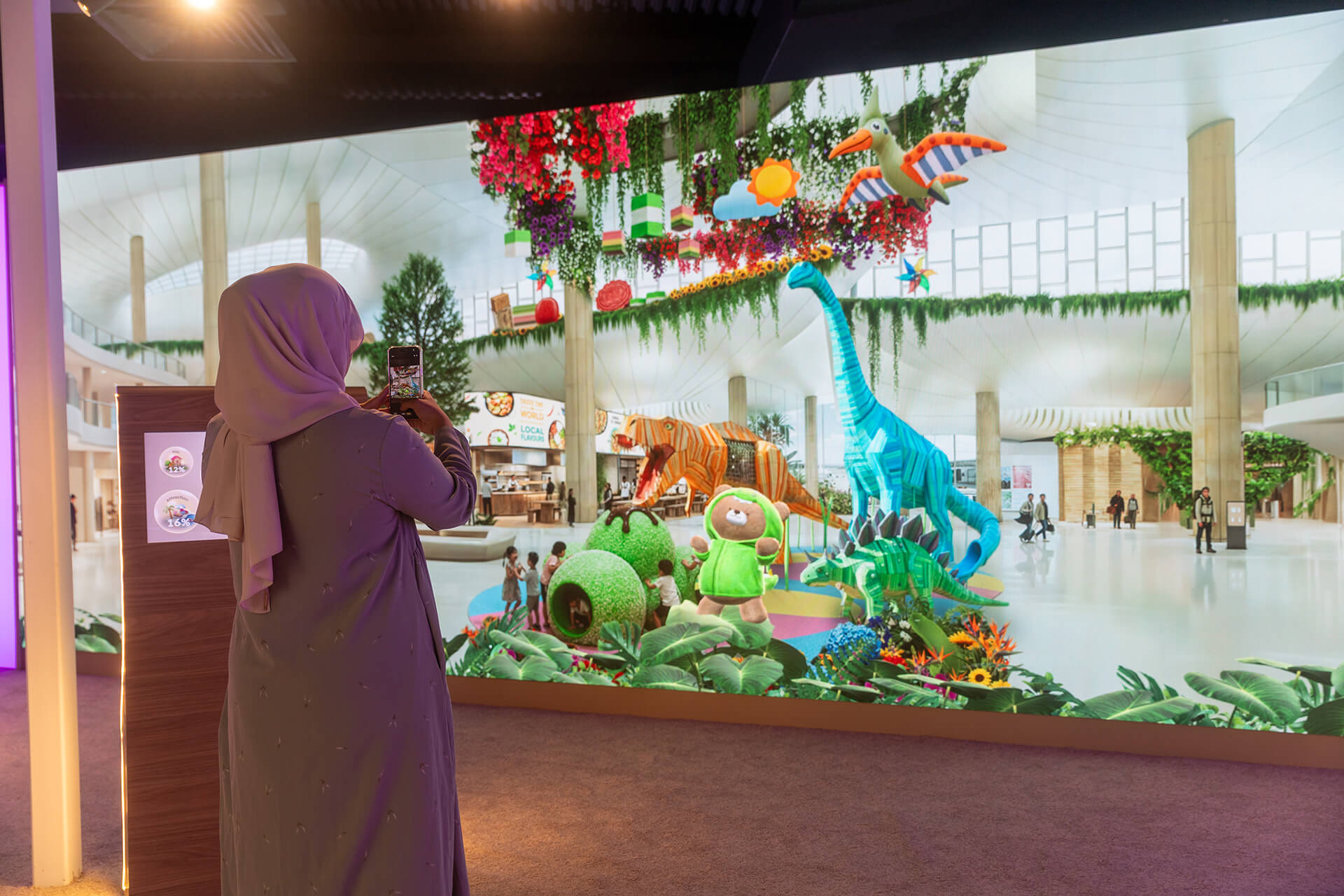
Case in point 1: T5 in the Making Exhibition (AI as a bridge to the not-yet-visible)
The terminal does not exist yet. That is the challenge. Instead of asking visitors to imagine it from architectural renders, the experience invites them to shape it. A simple preference indicator – nature, food, play, sport – feeds into an AI visualisation that shows them a version of the future terminal built around their own choices. The result is personal, shareable, and quietly useful: the collective preferences of thousands of visitors become real data that can inform how the space is actually designed.
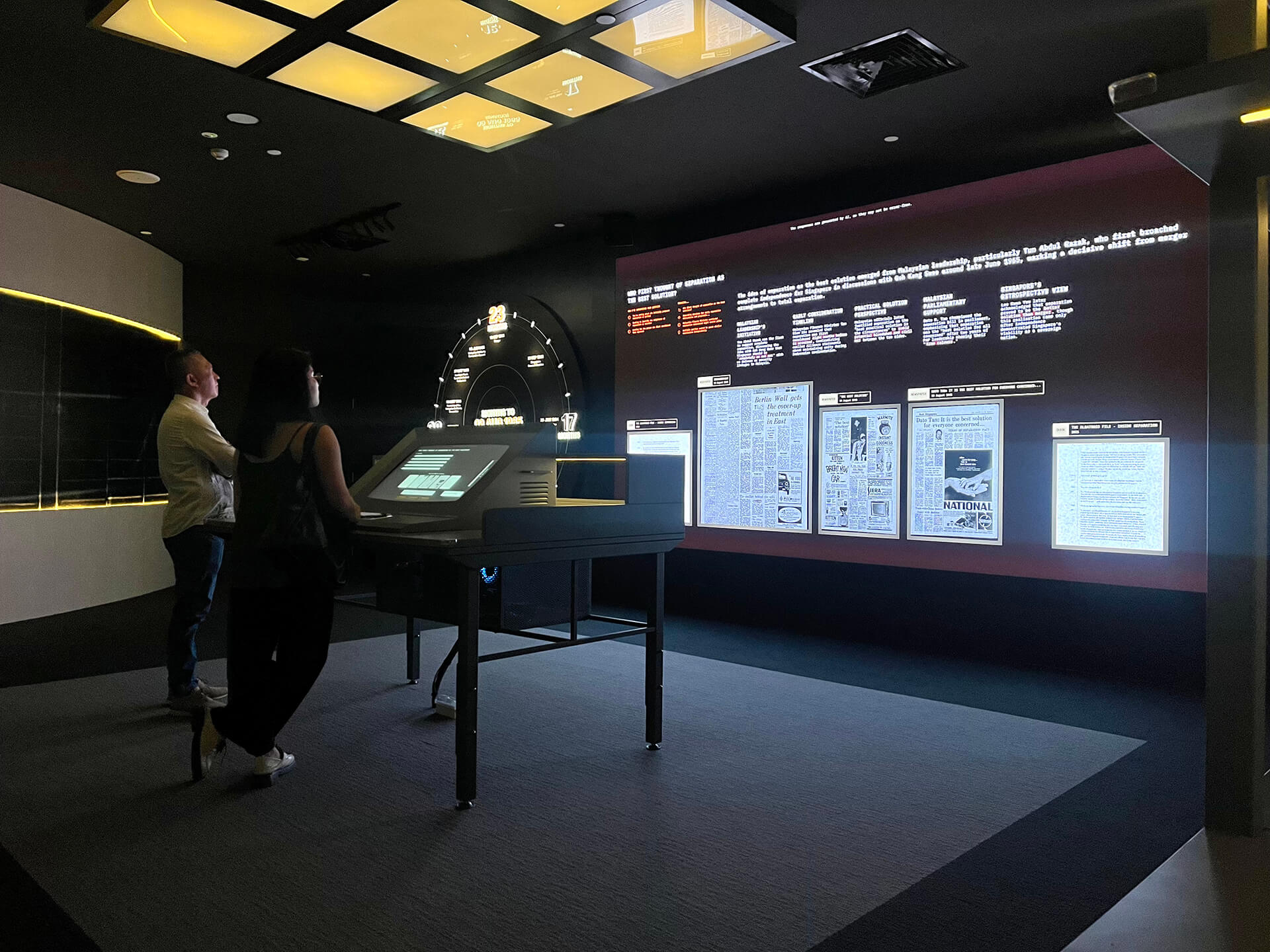
Case in point 2: The Albatross File (AI as archival interpreter)
This is not a chatbot. The AI does not generate answers. It retrieves them. Working across thousands of pages of declassified national archives, it surfaces the exact sources and excerpts relevant to each question a visitor asks. Visitors can then click directly into the original documents. The AI does not speak for history. It makes history speak for itself.
The hidden cost of AI
Even when the use case is sound, AI introduces design and operational costs that many teams overlook during ideation.
The subscription fee is the smallest line item. What teams rarely plan for is everything that follows: designing how the AI responds, setting the boundaries of what it will and will not say, calibrating its tone, building fallback behaviour for when it fails, training staff to manage it live. And after all that work, all those guardrails and safety filters, the resulting experience is often so locked down it becomes bland. Robotic. Not too different from a programmed chatbot. Less engaging, in many cases, than a well-written panel.
And then there is the question nobody asks loudly enough: how long does the novelty last? A generative AI feature might hold a visitor’s attention for thirty seconds. Whether it leaves a lasting impression, or just the memory of something that took too long to load, depends entirely on whether it was solving a real problem in the first place.

Level up, don’t layer on
The real maturity in AI-enabled experiences is not adding more intelligence to the interface. It is applying intelligence to the design decision.
At HOL, the measure is simple: which tools make the story land more clearly, more personally, more meaningfully. If AI is that tool, it earns its place.
If not, it is noise. And in public experiences, noise is expensive.