
In delivering a museum, gallery, or major exhibition, the most consequential decisions are usually made earlier than people expect. By the time a pitch process begins, much of what will shape the outcome is already in motion: the brief, the assumptions about scope, the criteria the institution will use to choose. The pitch is where these decisions are made visible. It is rarely where they are first made.
That is one of the reasons I find process so useful. A good process makes these early decisions deliberate. It is structured so that the thinking happens at the point where it can still shape the outcome.
For projects like this, there is a ten-step process I work to. It has come out of many years of practice across museums, galleries, attractions, and major exhibitions, and each step exists to address a specific risk that tends to surface if it is not accounted for. The full set is mapped below.
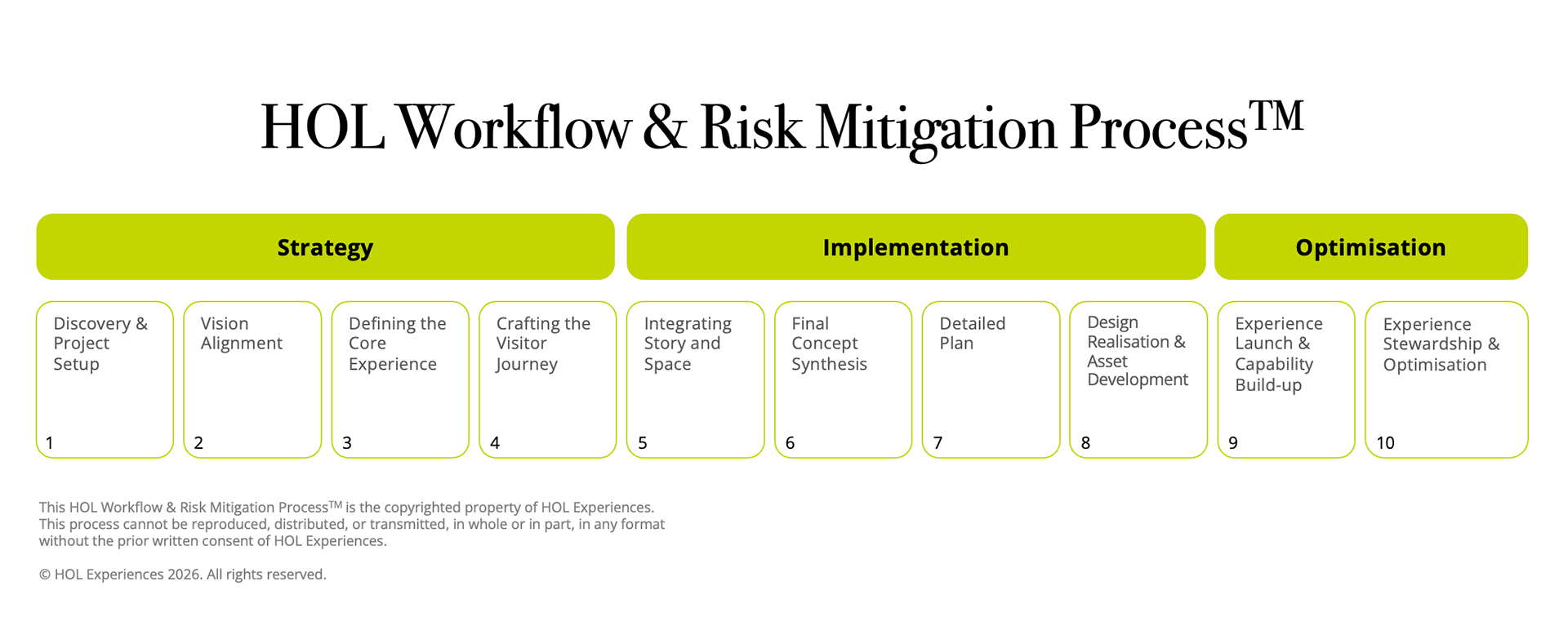
Of the ten, there are four where the substance of the work becomes most visible. Three of them produce a written document you can review in detail. The fourth produces a team that can carry the experience forward on its own.
Step 3: Defining the Core Experience
What is the Core Narrative, and why does it matter so much?
The Core Narrative is the foundational strategic answer to three questions. What does this institution need to communicate, and why should it matter to people walking through the door? How will that message resonate with this particular audience? What should it motivate them to think, feel, or do differently by the time they leave?
This is also the step where senior alignment is formally secured. The Core Narrative is shaped through direct engagement with the Chair of the project or the key senior management sponsor. Their vision informs it before the core narrative takes final form, and their sign-off fixes it. Once approved, it becomes the reference every later decision is measured against, including value engineering decisions during construction, giving design, build, and content teams a clear and stable governing brief to work from.
A question worth asking: can I see a Core Narrative from a previous project?
Step 6: Final Concept Synthesis
What is the Experience Masterplan, and how does it come together?
This step is a governance milestone as much as a creative one. By this point, the institution’s senior decision-makers should have been engaged in three structured input sessions. Three is the number I have found works. Fewer, and critical feedback arrives too late, when changes are disruptive and expensive. More, and the demand on senior schedules becomes unsustainable.
The Experience Masterplan that emerges from this step is the governing document against which all downstream work is benchmarked. It is what prevents the gradual drift that occurs when timeline and budget pressures start influencing decisions in isolation from the original intent.
A question worth asking: how many input sessions with senior decision-makers will it take to get to the Experience Masterplan, and what specific feedback is being sought at each?
Step 7: The Detailed Plan
What are Zonal Briefs, and why does the level of detail matter?
Zonal Briefs are documents that specify, for each zone of the experience, the content requirements, storytelling mediums, material finishes, and technological interactions. They sit alongside the architectural drawings, regulatory compliance documentation, and M&E drawings.
Together, they give contractors a complete and unambiguous picture of what needs to be built and to what standard. When this documentation is vague, two things happen. Contractors price with a risk premium, which makes the budget unpredictable. And the build phase becomes a series of improvised decisions that look minor in isolation but cumulatively dilute the experience in ways that are difficult to reverse.
A question worth asking: can I see a Zonal Brief from a previous project?
Step 9: Experience Launch and Capability Build-up
What does proper handover actually look like?
This step is two parallel transfers happening at the same time.
The first is to your front-of-house team. Through docent training and media briefing toolkits, they should be equipped to articulate the experience’s significance accurately and compellingly, to stakeholders, the press, and to visitors.
The second is to your operations team. They should be trained to operate the multimedia systems, to use the content management system to update content within the digital layers of the experience, and to manage first-level malfunctions without depending on external support for routine issues.
For you, this is the step that determines whether you can walk away knowing your team has it. Not “they will figure it out”. They have it.
An experience that cannot be explained well by the people who run it, or that stalls every time something needs attention, loses value far sooner than it should. This step is what determines what kind of experience you actually leave behind.
A question worth asking: who delivers the training for my front-of-house and operations teams, and how do you assess whether they are ready before handover is complete?
What this gives you
The other six steps matter, and any consultancy you speak to should be able to address each of them with the same clarity. Every step in the HOL Workflow and Risk Mitigation ProcessTM exists to address a specific risk we have identified over decades of practice. Most of those risks are predictable. What makes them costly is not their complexity, but the fact that they tend to surface after the window to address them has closed.
What a good process gives you is clarity at the moments that matter most. It makes the hard decisions happen at the right time, with the right people in the room.
This article is one of six that together form a downloadable guide for teams tasked with delivering a museum, gallery, or major exhibition. To request a copy, please email info@hol.sg.