
The Short Answer
AI helps museums, galleries and attractions keep improving the visitor experience after opening day by shortening the distance between what visitors signal and how the team responds. It can group scattered feedback by theme and flag what is starting to repeat, read movement data such as dwell time alongside queue length, staff observations and visitor comments, and turn the questions frontline staff hear every day into practical briefs for scripts, signs and FAQs. It does not decide what a pattern means or what should change. That stays with the people responsible for the experience, and success is measured by whether the operation responds to visitors better than it did before, not by how much AI has been adopted.
What does AI actually change after an experience opens?
Opening day may mark the end of the build, but it is only the beginning of understanding how an experience performs in the real world. As visitors move through the space, they continue to reveal what is working, what is unclear and where the journey needs more support.
Good operations teams have always listened. They review feedback, observe visitor behaviour and learn from the questions staff hear every day.
What AI changes is not whether this happens. It is how fast it happens, and how much of it a team can actually keep up with.
The visit starts before the visitor arrives
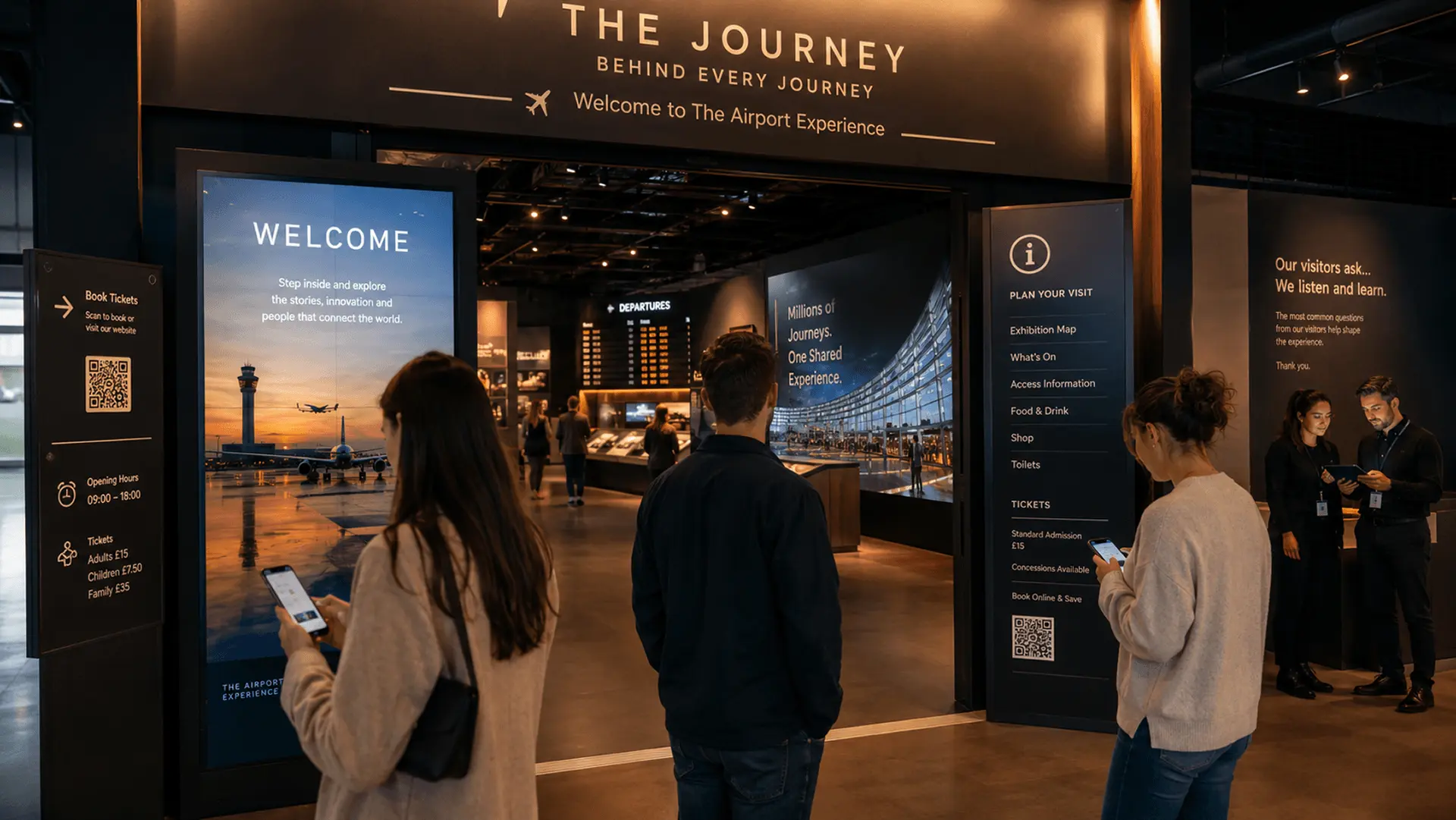
Many visitors are beginning their planning with a search engine, a social platform or an AI assistant, asking whether a venue is worth their time, what to expect and how long to allow. Wherever that planning begins, it shapes an expectation before the physical experience has had the chance to speak for itself.
A venue cannot see a visitor’s private conversation with a general AI assistant. What it can see are related signals across its own channels: website searches, chatbot logs, booking enquiries, customer-service emails, social comments, online reviews and the questions frontline staff hear repeatedly.
A venue can also ask the same questions itself. Putting the questions a visitor is likely to ask, such as whether the venue is worth the trip, how long to allow and what not to miss, to the main AI assistants shows what they are telling people about it. Where the answers are out of date, incomplete or wrong, the fix starts with the venue’s own website, FAQs and listings, which are among the sources those assistants often draw on. Answers vary between assistants and change over time, so this works best as a regular check rather than a one-off.
AI can help bring these sources together and surface where expectation and reality are drifting apart. Visitors may keep expecting a highlight that is not there, misjudge how long the visit takes or arrive unsure what the experience is even for. These gaps may not be visible from inside the venue alone. They become clearer when the information a venue already holds is read together rather than separately.
Where AI earns its place: three examples
Rather than list every place AI could plug into an operation, it is more useful to focus on the few areas where it changes what a team can see and respond to, not simply what it can automate.
1. Turning scattered feedback into an operational priority
Most venues already collect more feedback than they can consistently review: surveys, comment cards, online reviews, emails, staff observations. For many venues, the problem is not a lack of data. It is the time it takes to read all of it closely enough, often enough, to tell an isolated comment apart from a pattern that is just starting to form.
AI can group open-text feedback by theme and flag when a particular issue starts appearing more often. Frequency is not the only test, though. A single comment about an accessibility barrier or a safety risk may need action that day, however rarely it appears. Instead of waiting for a quarterly report, a team can review a weekly summary of what is rising, what is stable, and what has been resolved.
The team still decides what the pattern means. It checks the finding against staff experience, identifies the likely cause, and chooses the response. A confusing arrival instruction might call for a website update. A repeated complaint at one junction might call for better signage, or a host placed at the point of uncertainty.
The result can be measured: fewer repeated questions, fewer complaints about the same issue, less staff time spent managing it or higher satisfaction at that touchpoint. AI shortens the distance between a visitor raising a problem and the team being able to act on it.
2. Reading movement data in context, not as a heatmap alone
Dwell time and movement tracking already help teams understand how visitors use a space. AI adds the ability to question that data in plain language and read the answer alongside everything else the team knows.
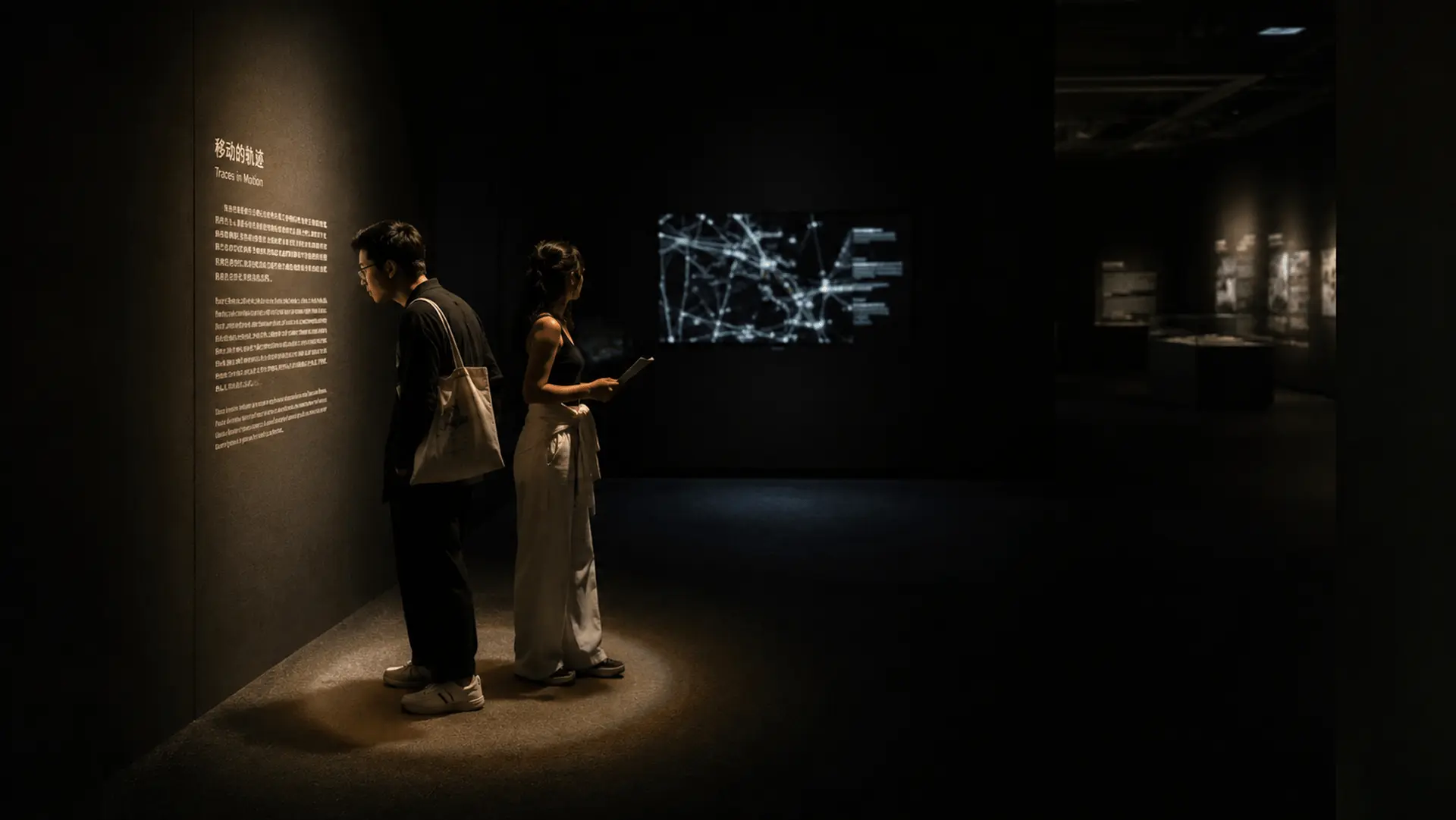
A heatmap on its own cannot tell you why visitors paused. A long pause might mean they are absorbed. It might mean they are lost, waiting for an interaction to respond or unsure what to do next. AI becomes useful here not by resolving that ambiguity on its own, but by bringing the pause together with other signals: whether the interaction was completed, how long the queue behind it was, what staff observed and what visitors said afterwards.
It helps the team ask a more precise question: are visitors pausing because the content is holding their attention, or because the next action is unclear? The combined data can point the team towards a likely explanation, but it is not proof of what a visitor was thinking.
The response depends on that distinction. An engaged pause may need nothing at all. A confused pause may need a clearer instruction, a repositioned host or a shorter sequence. A pattern of drop-off at the same point may mean the experience is asking for more time than it has earned.
The value is not a smarter heatmap. It is a faster route from behaviour to a testable change, followed by watching whether the change actually worked.
3. Closing the loop between content and operations
Some of the most valuable uses of AI may never be visible to a visitor. They happen when the questions frontline staff hear every day start shaping the scripts, signs, FAQs and digital information that other teams manage.
Operations and content teams often work from different sources, on different timelines. AI can help build a shared view of what visitors are actually asking, where the story is landing, and where the wording is creating doubt. A weekly pattern of questions becomes a practical content brief, rather than staying scattered as individual anecdotes nobody has time to compile.
The response is often small: one line in a host script rewritten, an instruction moved closer to the decision point, an FAQ rewritten to match the question actually being asked. For a brand experience, it might reveal that visitors remember the spectacle but miss the message the space was built to carry. The visitor never needs to see the technology behind it. They experience the outcome: a journey that feels a little clearer and a little more considered than it did last month.
Measure the improvement, not the presence of AI
The success of this approach should not be measured by how much AI a venue has adopted. It should be measured by whether the operation responds to visitors more effectively than it did before.
The right indicators will vary by venue, but they may include fewer repeated wayfinding questions, lower complaint volumes at a known touchpoint, smoother queue movement, higher completion of key interactions, stronger recall of the core message or less staff time spent manually sorting feedback that AI can help triage.
A useful starting point is small: select one issue, establish a baseline, make one focused change and observe what happens. AI can help identify the issue and track the signal without requiring someone to read every comment manually. It can also show whether the indicators are changing. But deciding whether an intervention truly improved the experience still requires operational context and human judgement.
Guardianship, not installation
AI-enabled operations need ongoing guardianship. The information being analysed has to be relevant and responsibly collected. Outputs need to be checked for accuracy, bias and missing context. Visitor privacy, data access and retention should be considered from the start, not bolted on after the system is already running.
The same applies to anything visitor-facing. Tone and recommendations can drift as content changes and the questions visitors ask evolve. A venue needs clear ownership: who reviews the output, who decides when information gets updated, and who is accountable when the system gets it wrong. AI cannot be installed and left alone. Its usefulness depends entirely on how closely the organisation keeps guiding it.
Guardianship also means stepping back at set points to look at the whole experience, not only at what the data reports. Some things never show up in visitor data at all: a faded panel, a light that no longer falls where visitors stand, a sign now hidden behind new furniture. HOL’s team returns to the spaces it has delivered at regular intervals. At the CJ Koh Gallery at the NIE Library, a revisit a year after handover found the panels in the condition they were installed in and the gallery’s story still on point, so the right call was to change nothing. A structured check such as the Day 90 Experience Audit turns that step back into clear decisions. Where no one inside the organisation can take it on, an external reviewer can carry it as a short experience audit.
What has to be in place before opening day for AI to help?
AI helps most when an experience was built to be improved, and much of that is decided during design and build. Existing venues are not too late: they can set a baseline now and start with the touchpoints that are easiest to change. Four conditions matter.
(i) A baseline. If nobody records how visitors move, what they ask and where they struggle in the first weeks, there is nothing to compare a change against, and AI can only describe the present.
(ii) Content that can be changed. The fixes described above are small: a line in a host script, a sign moved closer to the decision point, an FAQ rewritten to match the real question. They stay small only if scripts, signs and digital content were built to be edited after launch, without a contractor’s change order for every word.
(iii) Clear ownership. Someone has to own what the operation learns, decide what gets acted on and be accountable for the result. Without that, the summaries arrive and nothing changes.
(iv) An operations team ready to read the signals. Handover should include training for the people who will run the experience, not only those who guide visitors through it, so they can test what AI surfaces against what they see on the floor.
All four can be written into the brief or tender, while they can still be specified rather than retrofitted.
The future is AI-informed improvement
The opportunity here is larger than a smarter visitor-facing feature. It is a shift from relying only on occasional post-opening reviews towards a more continuous understanding of how the experience is actually performing.
That does not mean changing the space every time a new comment appears. It means seeing the pattern early enough to make a considered call: what should be left alone, what needs a small adjustment, and what points to something deeper in the journey that needs real attention.
Opening day completes the build. It rarely completes the experience. The months that follow reveal what visitors actually do, what they ask and where the story holds or begins to drift. AI can help teams recognise those signals sooner, rather than reconstructing them months later from a report. What happens next remains a decision for the people responsible for the experience.
If visitors keep asking the same questions, stalling at the same interaction or leaving without the message the space was built to carry, it may be worth stepping back to look at the journey as a whole. HOL’s experience audit is a short review built on the Day 90 Experience Audit, designed to find where an experience is losing clarity and what to change first. Get in touch if you would like to talk it through.
Questions this might raise
Can a museum or attraction find out what visitors expect before they arrive?
Partly. A venue cannot see what a visitor asked a general AI assistant, but it can ask the main assistants the same questions itself and see what they say about the venue. Its own channels add the rest: website searches, chatbot logs, booking enquiries, customer-service emails, social comments, online reviews and the questions frontline staff hear repeatedly. Read together, these show where expectation and reality are drifting apart, such as a highlight visitors keep looking for that is not there, or a visit length they keep misjudging.
Once a corporate experience or innovation centre is open, how do you tell whether visitors are getting the message?
Ask them. A host asking at the end of a visit, or a one-question exit survey, inviting visitors to name one thing they will remember is the simplest recall test. The standard worth holding it to is whether a visitor with no background in your field can repeat one true thing about your work in their own words. Frontline staff questions and visitor comments, grouped by theme with AI’s help, then show where the story is landing and where the wording is creating doubt.
Can a museum or attraction start improving the visitor experience without movement tracking or new hardware?
Yes. Most venues can start with what they already have: survey and review comments, booking and customer-service enquiries, chatbot logs and the questions frontline staff hear every day. These show where visitors are confused or disappointed without any new equipment. Movement tracking adds depth later, when a team needs to see where in the space a problem occurs and test whether a change has fixed it.
How do you measure whether a visitor experience has improved after opening?
Measure the visitor outcome, not how much AI has been adopted. For attractions, that includes longer visits against a comparable baseline, repeat visits and review ratings. For any venue, it includes fewer repeated wayfinding questions, lower complaint volumes at a known touchpoint, smoother queue movement, higher completion of key interactions, stronger recall of the core message and less staff time spent manually sorting feedback. Start with one issue: establish a baseline, make one focused change and observe what happens.
What should an exhibition brief include so the experience can keep improving after opening?
It should require a baseline of how visitors move, what they ask and where they struggle in the first weeks after opening. It should specify that scripts, signs and digital content can be edited after launch, through a content management system the client’s own team can use, without a change order for every word. It should name who owns what the operation learns and what gets acted on. And it should require a handover that trains the operations team, not only front-of-house staff, as set out in Step 9 of the HOL Workflow and Risk Mitigation Process™.