
Opening a museum, gallery, brand experience centre, or major attraction is a milestone that takes considerable time and care to reach. The visitors arrive, the press writes about it, the photographs are taken, the institution marks what has been delivered.
The months after opening bring a different kind of challenge. The questions from above shift from “will it open on time?” to “is it still working?” And answering that second question well, year after year, is its own discipline.
What tends to drift, quietly
A venue that is open and running well can still be drifting from what it was meant to be. The drift is rarely dramatic. It tends to happen in three quiet ways.
The first is in the story. The Core Narrative was sharp on opening day. In the months after, it begins to broaden. A sponsor is acknowledged. A partnership is celebrated. A panel is added to cover something that felt missing. A headline is shortened because it felt a little long. Marketing aligns a message to a current campaign. Operations adds a few signs for wayfinding. None of these changes is wrong on its own. Each was a reasonable response to a real need. The cumulative effect, though, is that what the venue stands for becomes less clear. Visitors leave having enjoyed themselves, but they cannot quite say what the place was about.
The second is in the signature moments. Every venue has a handful of moments that were designed to land. A view from a particular threshold. A specific interactive. A piece of audio or lighting at a particular point in the journey. These are what visitors remember and talk about. Twelve months in, these moments are usually still there, but slightly diminished. The audio is softer. The lighting has drifted. Interactive response times have slowed. The venue can look identical to opening day and feel less gripping than it did.
The third is in the venue’s place in the organisation’s life. On opening day, the venue is a centrepiece. The leaders who championed it speak about it often. Visiting delegations are brought through. By month twelve, the venue has often become part of the building. Internal mentions thin. The venue is still there, still functioning, still visited, but the institution’s active attention has moved on. This is the shift that most quietly determines whether the venue stays a priority when budgets are reviewed, and whether the next refresh is funded with care.
None of these shifts is unusual. They are the natural settling of a venue into an organisation’s daily life. They are also among the things most worth noticing in time to address them.
The three audits
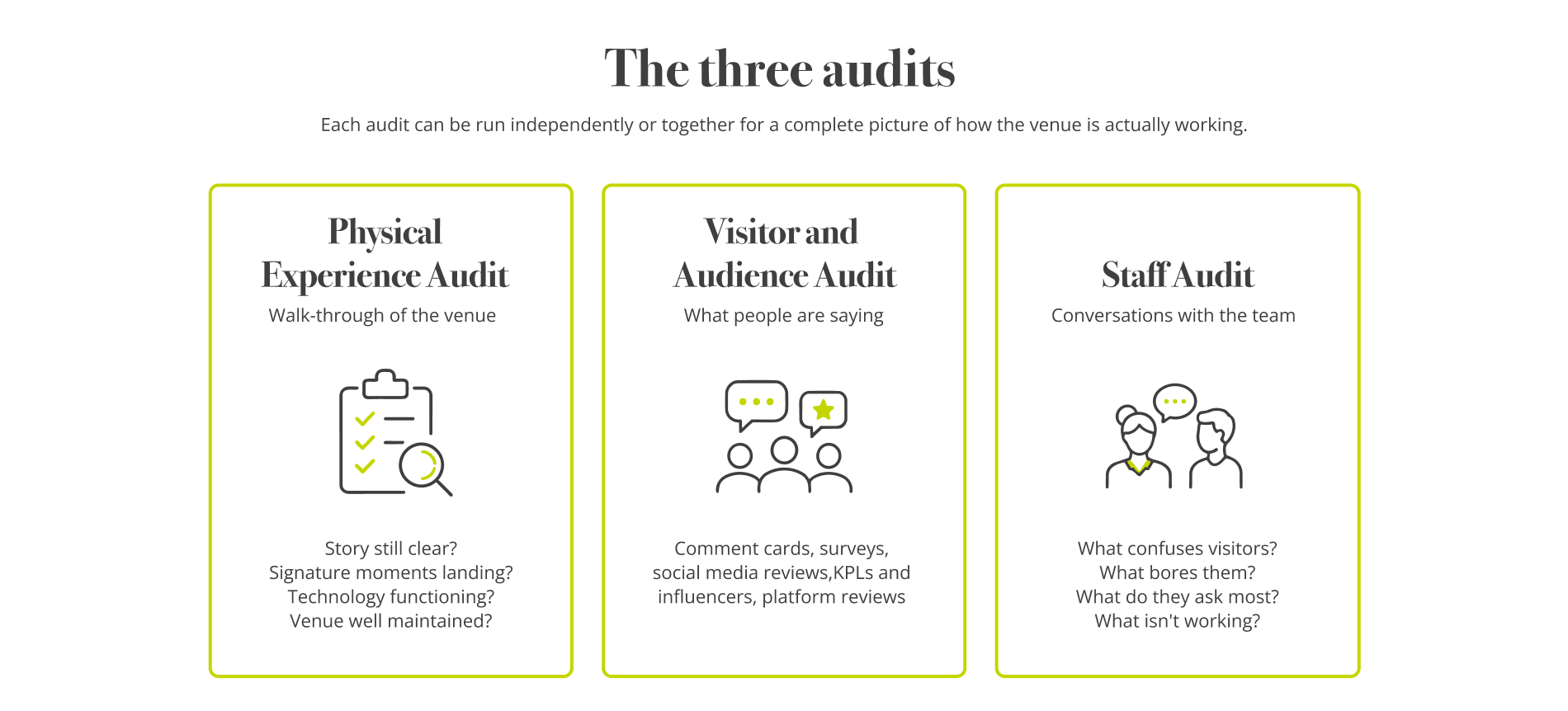
The most useful way to catch these shifts early is a structured audit of the venue. A good audit is not a single walk-through. It is a set of three perspectives that together give a complete picture of how the venue is actually working.
The physical experience audit. A structured walk-through of the venue itself. It looks at whether the story is still clear, whether the signature moments are still landing, whether the technology is functioning as designed, and whether the venue is being cared for in the small details that shape how it feels.
The visitor and audience audit. A structured look at what people are saying about the venue, both directly and online. From visitors, this includes comment cards, surveys, direct feedback to staff, and complaints and compliments logged. From the broader audience, it includes social media posts, online reviews, and what key opinion leaders and influencers are saying on their blogs and channels. For venues that draw a public or tourist audience, third-party review platforms such as Tripadvisor and Trip.com are also worth monitoring. The gap between what the venue intends and what people report is often where the most useful insights live.
The staff audit. A set of conversations with the people who work in the venue every day. They see what visitors do, what confuses them, what bores them, and what they ask about most. Staff insight is often the most direct route to what is and isn’t working, and it is often the least systematically captured.
The three audits can be commissioned together for a full picture, or any one of them on its own as a useful starting point.
When to do them
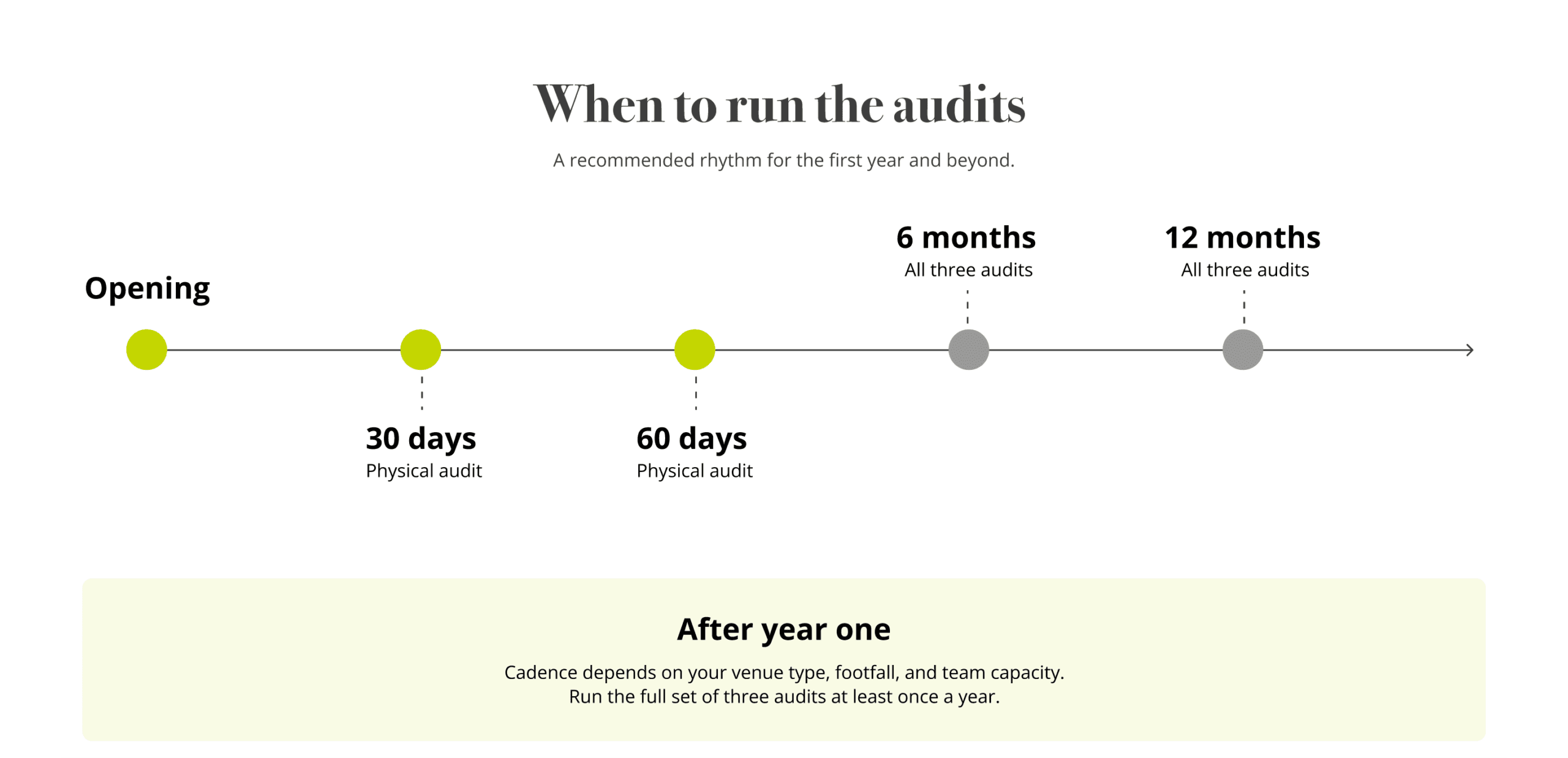
The three audits do not all need to happen at the same time, and they do not all need to happen at the same cadence.
The first 30 and 60 days are when operational shifts surface fastest. Audio drifts. Lighting changes. Small signs get added. Interactive response times begin to slow. These are easier to correct quickly, while the venue is still close to its opening state. A tactical physical experience audit at each of these early intervals tends to catch what matters most before it becomes the new normal.
The 6-month and 12-month marks are when the picture deepens. By 6 months, enough time has passed for the strategic shifts to become visible. Whether visitor dwell time and engagement with the key moments in the space have held up. Whether the front-of-house team is still telling the story with the clarity and conviction they had at opening. The 6-month audit brings all three perspectives together for a fuller view, and the 12-month audit does the same with the benefit of another six months of operational experience.
After the first year, the right cadence for the audits will depend on the nature of your venue. A public-facing attraction with high footfall and constant visitor turnover will need more frequent attention than a corporate museum or gallery that receives controlled visits. The internal team’s bandwidth and budget are also worth factoring in. What matters is that the rhythm is regular enough to catch drift before it becomes the new normal, and realistic enough to be sustained year after year.
Who is best placed to run them
There are three options worth considering, and the right one depends on your venue and your team.
The first is the internal team. Their advantage is daily knowledge. They are in the venue every day, they hear what visitors say, they know what has changed and why. The discipline of an honest internal audit can also strengthen the team’s sense of ownership over the venue. The challenge is the one all daily teams face. The longer you are inside something, the harder it becomes to see it with fresh eyes. The team is also often stretched, and a thorough audit takes time and a particular kind of attention that is hard to find inside a full operational schedule.
The second is the team that designed and delivered the venue in the first place. Their advantage is memory and distance. They remember what the venue was meant to do, what each moment was designed to achieve, and what the original Core Narrative committed to. They can see, often quickly, what has shifted. They also bring the perspective of having seen how venues tend to evolve over time, which sharpens what they notice. Not every consultancy offers this as a service beyond delivery, so it is worth asking early whether ongoing audit support is something they provide.
The third is an experience consultancy that offers audit services independently. This is worth considering when the original design team is no longer available or when a genuinely fresh perspective is needed. Look for a consultancy that has delivered museums, galleries, or attractions rather than one that conducts general audience or marketing research. The two are not the same thing. For this option to work well, the internal team will need to brief the consultancy on the provenance of the space, so they can audit with the right frame of reference from the outset.
A final thought
The venues that endure tend to be the ones where this kind of structured attention has become routine. Beyond what the audits surface, they give you something equally useful: a clear and defensible way to speak about the venue in board reviews, budget conversations, and discussions with senior leadership, and the confidence that what was built to last is being looked after well enough to do so.
This article is one of six drawn from a downloadable guide HOL has put together for teams tasked with delivering a museum, gallery, or major exhibition. To request a copy, please email info@hol.sg.