
Three documents do a great deal of work in delivering a museum, gallery, or major exhibition: the Core Narrative, the Experience Masterplan, and the Zonal Brief. Each is produced in the early stages of a project, when the intention behind the experience is being shaped and aligned.
Once work on the space begins, what gets built can start to drift from what senior leadership approved. This drift is one of the most common and costly problems in this kind of project. It is also largely preventable.
It rarely starts with a big decision. More often it begins with a design adjustment made under time pressure, or a cost-saving change that seemed reasonable at the time but was never checked against what had been approved. By the time anyone names it as a problem, several such moments have usually already passed.
The three documents prevent that drift. They work together, each responsible for a different stage of the journey from vision to opening. Having any one of them without the others tends to leave a gap.
Three documents, three different jobs
Each of the three documents works at a different level. Each serves a different function. And each depends on the one before it.
The Core Narrative
The Core Narrative is the foundational strategic document. It is produced before any spatial or content decisions are made. It answers the questions that no other document in the process addresses: what is this institution uniquely positioned to say? What should visitors feel, believe, or do differently by the time they leave? What does success look and feel like beyond footfall and satisfaction scores?
Answering them usually requires the input of senior leadership.
The Core Narrative records those inputs. It becomes the foundation on which everything else in the project is built. It is also the institutional position that senior leadership has approved. Without it, even the most beautifully designed space may not be the success the institution set out to achieve.
The Experience Masterplan
The Experience Masterplan takes off from the Core Narrative. Where the Core Narrative answers what the experience is for, the Masterplan answers how that intent will be expressed across the space.
What it establishes is the experiential architecture of the space: how the overall narrative is allocated across zones, what each zone is responsible for communicating, what the visitor journey looks like as a whole, and what visitors should take away from each stage of that journey.
The Experience Masterplan is produced after the Core Narrative has been completed and senior stakeholders have aligned. It comes before any design or spatial decisions are made. All subsequent work is held against it.
It is also what allows a senior leader to understand, without reviewing design specifications or contractor reports, whether the experience is on track to achieve what it set out to do.

The Zonal Brief
Where the Experience Masterplan works at the strategic level, the Zonal Brief works at the level of execution. It takes each zone defined in the Masterplan and breaks it down, exhibit by exhibit, into the precise information that designers, content developers, and contractors need to build it correctly.
For each exhibit, the Zonal Brief answers a specific set of questions. What is the key message of this display? What emotion should it evoke? What should it motivate the visitor to do or feel? What are the spatial constraints it needs to work within? What are the design requirements? What materials and dimensions apply? How long should a visitor reasonably spend here?
These are not creative questions. They are operational ones. Left unanswered, they are where drift begins.
Contractors working without a Zonal Brief have incomplete instructions. When specifications are absent, the default tends to be what is practical and easiest to build rather than what serves the visitor’s experience. A well-written Zonal Brief removes that ambiguity. It gives the institution, the designers, and the contractors a shared and specific picture of what success looks like for each element of the build.

The chain from vision to visitor experience
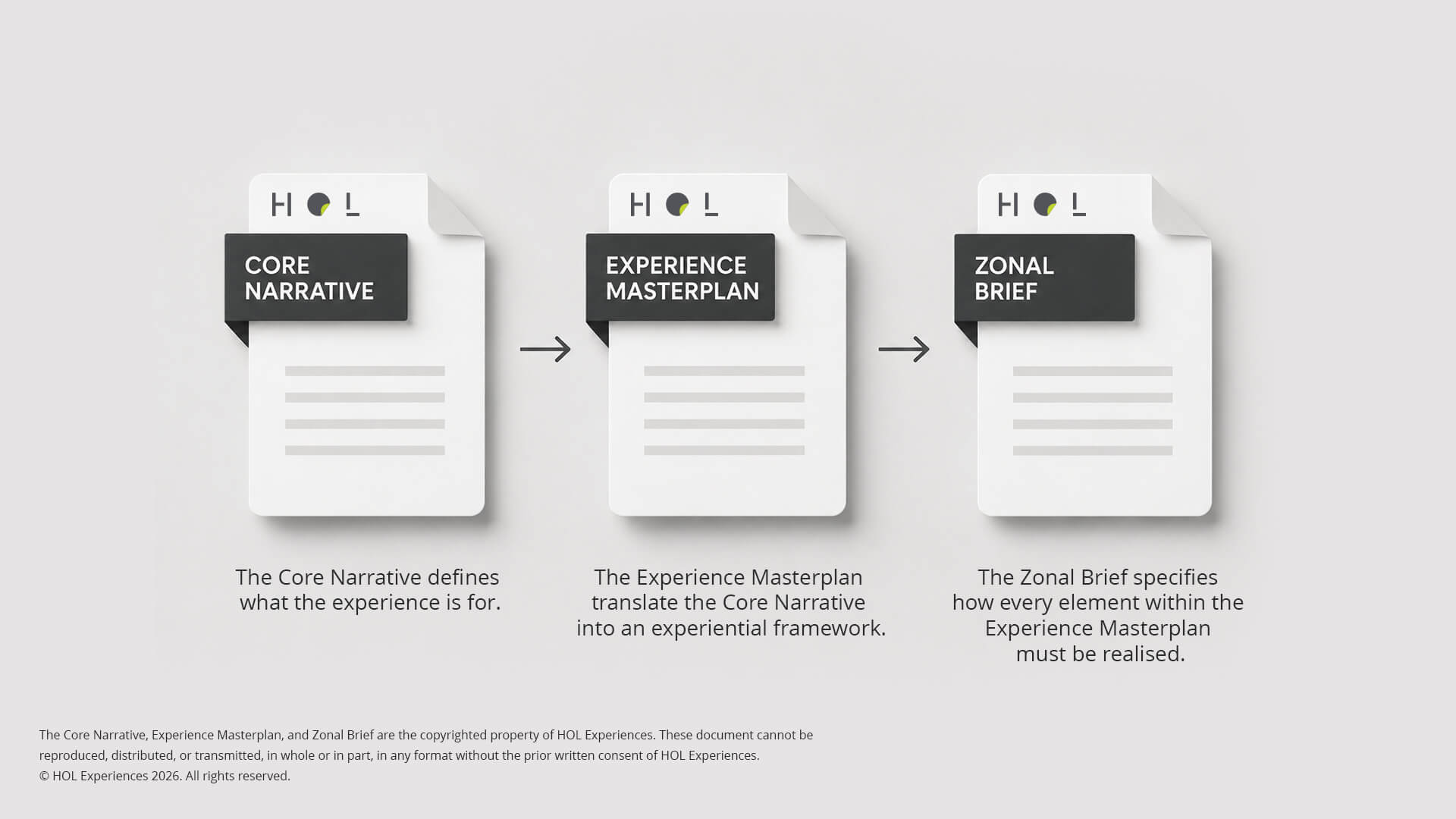
Together, the three documents create a coherent chain of accountability from the first conversation to opening day. The Core Narrative records what the institution intends to achieve and carries the endorsement of senior leadership. The Experience Masterplan translates that into an experiential framework that all subsequent work is held against. The Zonal Brief specifies how every element within it must be realised.
Launching a museum, gallery, or a major exhibition takes months, sometimes years. Teams change, priorities shift, and new people join at different stages. What was once a clearly understood intent may become an approximation of itself by the time the doors open.
With all three documents in place, the institution’s original vision is much more likely to be the experience visitors feel when the doors open.
This article is one of six drawn from a downloadable guide HOL has put together for teams tasked with delivering a museum, gallery, or major exhibition. To request a copy, please email info@hol.sg.